Let me start with a confession: I can barely draw a stick figure.
If you hand me a pencil and a blank piece of paper and tell me to draw a beautiful, vintage-inspired illustration, I will fail miserably. When I first started in Print-on-Demand (POD), I thought this was a death sentence. I thought you had to be a classically trained illustrator to build an apparel brand.
What I eventually learned is that in the world of modern e-commerce, you don’t have to be a great illustrator. You just have to be a great Art Director.
Your job isn’t necessarily to draw the lines; your job is to curate the vibe, set the constraints, and piece together elements until they create an emotion.
Today, I’m opening up the doors to my studio. I am going to show you my exact, step-by-step process for creating a new design—from a messy Pinterest board to a $35 bestseller on my store.
Step 1: The Anti-T-Shirt Moodboard
When most POD sellers want to make a new design, they go to Pinterest or Etsy and search “cool t-shirt designs.”
Never do this. If you look at t-shirts to design t-shirts, you will only ever create derivative, copycat work. You will end up blending into the noise of a million other Shopify stores.
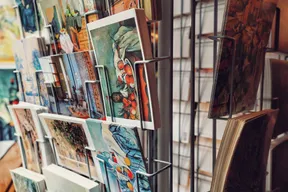
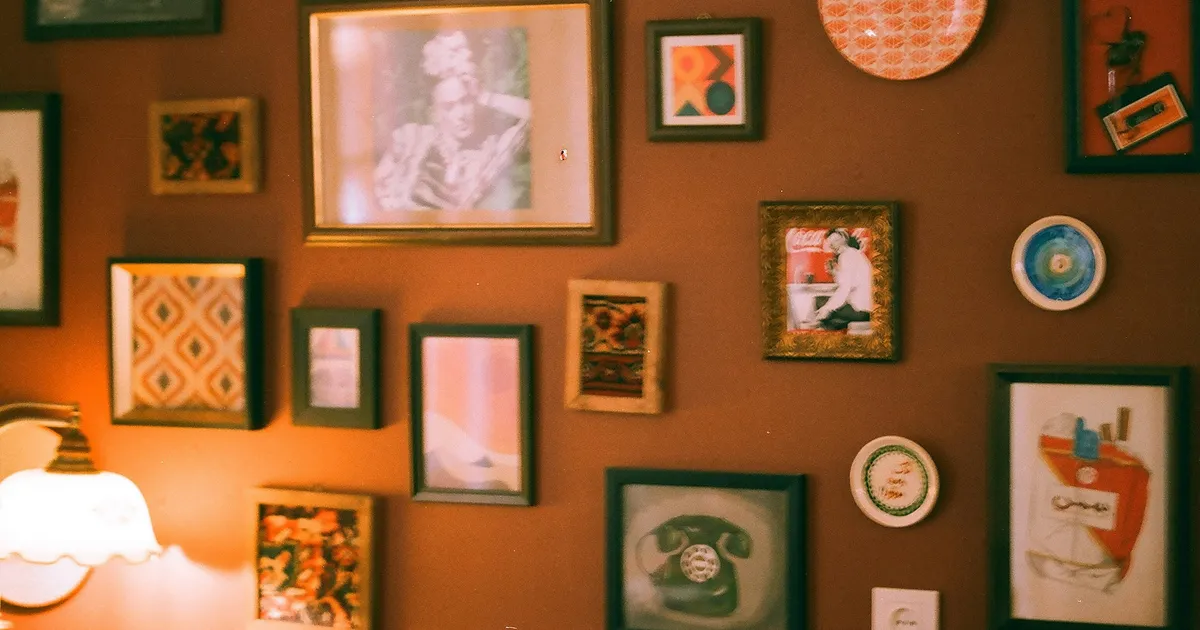
Instead, I search for the feeling I want the collection to evoke. If I want a nostalgic, slow-living autumn vibe, I search for:
- Vintage matchbox art from the 1970s.
- Old jazz club posters.
- Film photography of foggy cabins.
- Menus from aesthetic indie coffee shops.
I pin 20 to 30 of these images to a hidden board. I am not looking for illustrations to steal; I am looking for textures, color palettes, and typography layouts.
Step 2: Extracting the DNA (Colors & Fonts)
Once the moodboard is full, I look for patterns.
Maybe I notice that four of the vintage posters use a very specific faded mustard yellow and a muted forest green. Boom. That is the color palette for this design. I use a free color picker tool to grab those exact HEX codes.
Next is typography. I’ll look at the old matchboxes and notice they use a heavily serifed, slightly distorted font. I will go to a site like Creative Market or Google Fonts and find a typeface that mimics that exact vintage energy.
Before a single illustration is drawn, the DNA of the design is already established.
Step 3: The Rough Draft (or The Brief)
At this point, I have two choices depending on the complexity of the idea:
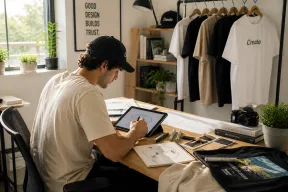
Option A: The DIY Route (Typography Focus) A lot of my bestsellers don’t even have illustrations. They are just beautifully arranged text. I will jump into Illustrator (or a web tool like Kittl), type out a poetic phrase that fits my brand’s lore, apply the colors and fonts I just found, and add a subtle grain texture so it doesn’t look too “digital.”
Option B: The Freelancer Brief (Illustration Focus) If the design requires a beautiful drawing of a pine tree or a coffee cup, I hire an illustrator on Fiverr or Upwork. But I don’t just say, “Draw a cool tree.”
I send them a highly specific brief. I give them the exact color palette (the HEX codes). I send them 5 reference images from my moodboard to show the style of drawing I want (e.g., line-art, vintage stamp style, no shading). This is the secret to getting a $20 Fiverr illustration to look like a $1000 agency design—you have to give them absolute artistic direction.
Step 4: The “Vibe Check” (Placing it in the World)
A design might look great on a flat white artboard, but look terrible on a human body.
Before I ever publish a product, I take the transparent PNG file and lay it over a mockup of my premium Comfort Colors blanks. Then, I apply my brand’s signature photo filter (low exposure, high grain) to the mockup.
This is the ultimate test. I step back from my monitor and ask myself:
- Does this look expensive?
- Would I personally wear this to a coffee shop?
- Does this fit seamlessly next to the other items in my store?
If the answer is no, I scrap it or tweak it. If the answer is yes, it gets exported, uploaded to Shopify, and prepared for launch.
The Takeaway
Good design is not magic. It is a systematic process of curation and restraint.
You don’t need to be Da Vinci. You just need to have a clear vision of the aesthetic you want to put into the world, and the discipline to build a moodboard before you ever touch the canvas.
Stop staring at blank screens waiting for inspiration to strike. Go look at some old matchboxes instead.